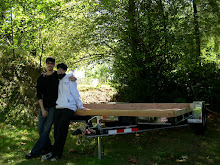
Wednesday, February 24, 2010

Little by Little...


I cut most of the insulation while D K read David Sedaris essays to me-hilarious!!  Now it's in a spare room at our current place waiting to be pieced back in like a ridiculous jigsaw puzzle.  But it's indoor work so we got it done while it rained.

Ludwig is showing off our cypress bathtub.  It's 4 feet long, 2 feet wide, and 3 feet tall.  It will go in the back left corner.

Custom wiring...


 by Jim.  He is a man of many talents and he has a heart of gold.
He and his rig may haul us to our first playground.

Only weeks left of winter..

We welcome spring.


It won't be long now...

Sunday, February 14, 2010

Miss Mazy Understood by Anita Bretha Freshair


I know a girl named Mazy
Miss Mazy Understood
One girl called her crazy
But she misunderstood

I can't really say why
But that girl  couldn't see
Mazy lived her life
With Chemical Sensitivity

The girl said Mazy thought
She's more important than others
But Mazy was always taught
We are all sisters and brothers

To live is to care
About all others living
To help and to share
Have hearts that are giving

It seems a bit twisted
To think perfume's a right
The "rights" that girl misted
Turned Mazy in fright

If she thinks it's okay
To wear perfumes and scents
Why not mist Raid
It's an equal offense

Calling Mazy an ingrate
And also a fake
This girl's words seem harsh
And too much to take


Miss Understood, she just
Wants fresh air
And maybe for a few
More people to care...
Less people who judge
More people aware


Miss Mazy Understood, she'd studied,
She knew her stuff
Avoiding chemicals is key
But that was going to be tough

It affects every part
Of Mazy's day
But her sweetheart
Helps her find her way

He loves the forrest
He's perfect for Mazy
She found an angel
And he found a daisy

Living with illness
Can be really scary
He's a wolf, he's protecting
His little canary

He gave his heart
Unconditionally
Now they're building a house
A safe place to be

The road might be rough
But their house has wheels
Mr. Understood
He cares how she feels

So when others have
Silly things to say
Letting ignorance and emotions
Get in the way

They take a deep breath
In air that seems clean
And go on with their life
Fulfilling their dreams

Monday, February 8, 2010

DU: International Crime in Progress


Exposures to Depleted Uranium (DU) and DU dust continue to pose health problems for US troops, their spouses and offspring. The people of Afghanistan and Iraq are undeniably suffering it's effects with illnesses comparable to Hibakusha, or "those affected by radiation" after the US dropped nuclear bombs on Japan.  
How can we stand by while US soldiers are ordered to use weaponry that will contaminate their own environment? DU explodes into dust that can be breathed/ingested. These particles are radioactive, chemically toxic, cannot be cleaned up, and cause chronic and life-threatening illness. Even before exploded, boxes of DU, used as seats, have caused rectal cancer. With over half of Gulf War Vets on permanant disability and a 10-fold increase of cancer in Iraq, why do we remain blind to a problem that has existed for over 20 years?  
Nuclear scientist, Dr. Rosalie Bertel, has done extensive studies that shed light on DU's toxic effects on the brain, causing aggressiveness and other behavioral problems.  
Major Doug Rokke, US Army veteran, with a PhD in health physics and forensic science, was exposed to DU and continues to study, speak and work toward an end to it's use. 
As does Dr. Loren Moret, geoscientist and whistleblower at Livermore Nuclear Lab, currently studying the effects of DU in Afghanistan and Iraq through private funding.  
Dr. Asaf Durakovic, chief of Nuclear medicine at a veteran's hospital in 1991, was terminated for researching the effects of radiation exposure.  With hope that adherence to the international bans on DU use were imminent, upon his death in 2004 a US soldier donated his body to Dr. Durakovic as evidence of DU effects.


Wednesday, December 30, 2009

Not Karen by Anita Bretha Freshair

Most folk jot about the day
No thought what scents
Might waft their way
And not a care
What scents they spray
Or what scents are made of, anyway.

Not Karen, though
She always knows
What's in your hair
And on your clothes
A scarf to cover
Her mouth and nose
She's chemical free
From head to toes

Karen has MCS, you see
Multiple Chemical Sensitivity
She told her dad, who still lit a smoke
Not carin' it literally made her choke
Then migraine, sinus, throat and chest pain,
And detoxing it out brings pain back again
Her dad makes her sick
It's really quite sad
But if he wants to be toxic
She can't have a dad

Her sisters love to wear per-fume,
Burn insence, and candles-not smart
Not carin' or wantin' to be told what to do
Karen's sisters are breaking her heart

She's Karen Canary, sick and afraid
Of what other people are wearin'
Most folk will just jot about their day
 But those folk are not Karen.

Wednesday, December 23, 2009

Susie Breaks It Down


What is Multiple Chemical Sensitivity?
by Susie Collins, editor at The Canary Report

tcrPeople with an exquisite sensitivity to toxic chemicals are often called “canaries.” The name comes from the old practice of miners who took canaries with them into the mines; if the canary died from toxic air in the shaft, the miners had time to escape with their lives. People with chemical sensitivities are the canaries of the modern world.
So how does a person develop chemical sensitivities? Sometimes exposure to toxic chemicals– maybe a one-time mega exposure or maybe a long-term micro exposure– can trigger a chronic illness called Multiple Chemical Sensitivity (MCS), where the person develops a hyper sensitivity to everyday toxic chemicals found in consumer goods and the environment.
Let’s see what the experts have to say about defining MCS. In 1999, a consensus was reached among a large group of specialists in defining Multiple Chemical Sensitivity. The abstract of their report reads:
Consensus criteria for the definition of multiple chemical sensitivity (MCS) were first identified in a 1989 multidisciplinary survey of 89 clinicians and researchers with extensive experience in, but widely differing views of, MCS. A decade later, their top 5 consensus criteria defining MCS are:
[1] a chronic condition
[2] with symptoms that recur reproducibly
[3] in response to low levels of exposure
[4] to multiple unrelated chemicals and
[5] improve or resolve when incitants are removed
[6] propose adding: requiring that symptoms occur in multiple organ systems.
These criteria are all commonly encompassed by research definitions of MCS.
Nonetheless, their standardized use in clinical settings is still lacking, long overdue, and greatly needed—especially in light of government studies in the United States, United Kingdom, and Canada that revealed 2–4 times as many cases of chemical sensitivity among Gulf War veterans than undeployed controls.
In addition, state health department surveys of civilians in New Mexico and California showed that 2–6%, respectively, already had been diagnosed with MCS and that 16% of the civilians reported an “unusual sensitivity” to common everyday chemicals. Given this high prevalence, as well as the 1994 consensus of the American Lung Association, American Medical Association, U.S. Environmental Protection Agency, and the U.S. Consumer Product Safety Commission that “complaints [of MCS] should not be dismissed as psychogenic, and a thorough workup is essential,” we recommend that MCS be formally diagnosed—in addition to any other disorders that may be present—in all cases in which the 6 aforementioned consensus criteria are met and no single other organic disorder (e.g., mastocytosis) can account for all the signs and symptoms associated with chemical exposure.
In layman’s terms, people with MCS react unfavorably when exposed to any amount, from minute to gross, of toxic chemicals from products such as pesticides, cigarette smoke, paint fumes, wood preservatives, photocopier fumes, perfumes and fragrances, laundry products, dryer sheets, air fresheners, and epoxy, among many others. Symptoms vary from fleeting to severe and might include rapid heart rate, shortness of breath, fatigue, flushing, dizziness, nausea, coughing, difficulty concentrating, problems with memory, migraine, or even life threatening seizures or respiratory distress. This chemical sensitivity condition is not rare and the numbers of people who have it are growing.
But the truth is, it’s not just chemically sensitive people who are being affected by a toxic environment. The general public is being exposed to tens of thousands of chemicals that didn’t even exist until a few decades ago. Many of these chemicals, some found in everyday household products like cleansers and cosmetics, are known to be or are suspected of causing cancer, reproductive problems, developmental disabilities, and heart disease.
People around the world are now sounding the alarm about toxic household cleansers, clothing and fabrics, electronics, cosmetics and personal care items, perfumes and fragrances, deodorizers, cleansers and soaps, all the products about which people with MCS have been alarmed for decades. But now trends are finally catching up, consumers are making smarter choices with non-toxic paints and building materials, organic gardens and foods, natural cleansers and fabrics, and electronics free from flame retardant. Until government and industry catch up with these progressive trends, the best course of action is to limit exposure and lead the healthiest life possible.
For more information about Multiple Chemical Sensitivity

For a list of citations for peer-reviewed journal articles that support a physiological basis for MCS, go to Research on Multiple Chemical Sensitivity, compiled by Professor Anne C. Steinemann and Amy L. Davis at University of Washington.
Multiple Chemical Sensitivity is recognized as a disability by the United States Social Security Administration, Department of Housing and Urban Development, and the Americans with Disabilities Act, among other government agencies. To learn more, click on the categories “Disability Rights” and “Worker’s Rights.”
To learn more about safe housing, click on Multiple Chemical Sensitivity and Safe Housing.
Click here for links to more Resources.
Click here to learn more about Multiple Chemical Sensitivity from websites around the world.
Click here to visit The Canary Report blog.
Click here to visit The Canary Report social network.
Click on a specific category or tab listed in the right hand column for more information on a given topic.
Feel free to write me, Susie Collins, editor at The Canary Report, through the Contact page.
If you feel isolated or confused with your chemical sensitivities, take heart. The Canary Report is here to give you trusted news, information and inspiration!

Friday, December 18, 2009

Getting Energized

So much for our dreams of solar power.  We just can't finance it. Too bad, 'cause I'm sure it's the way to go.

But this means a friend will wire our tiny home instead of said solar guy.  We are blessed to have someone we trust to do this part of our project.

We will need to find someone to hook up our propane for the stovetop and heater.

A bonfire on the property where we are building, at the beginning of a burn ban, made bad air quality worse.  So we sealed the house up tight in a tarp, with some tu-tuff vapor barrier laid over the roof for extra protection from rain, and took a week off.

D K and I need to get energized, too.  D K caught a cold after the roof  build in the cold snap.

We need to purchase torrefied cedar siding and steel corregated roofing, along with ice and water sheild, an alternative to tarpaper.

Winter Solstice is almost here, so days will get longer and we will celebrate the Sun, though not as part of our power plans.